The price you sign is the price you pay. Every extra priced on day one. Nothing paid upfront. How it works
Services All services ExtensionsKitchensBathroomsLoft ConversionsRenovationsStructural Work
About Our Work Cost CalculatorLoft Conversion CostsExtension CostsGuides
Areas All areas BromsgroveAlvechurchBarnt GreenBlackwellRedditchBirminghamKings NortonNorthfieldSelly OakSolihullHalesowen
Contact Get a free quote
Home / Guides / Do you need planning permission for an extension
Guide · Extensions

Do you need planning permission for an extension? Permitted development explained for Birmingham and Bromsgrove

Many single storey rear extensions don't need planning permission. Under permitted development you can extend 3 metres from the back of a semi or terrace, or 4 metres on a detached house, up to 4 metres high. Prior approval raises those limits to 6 and 8 metres. Anything bigger, or any house in a conservation area, usually needs a householder planning application.

Last updated November 2026
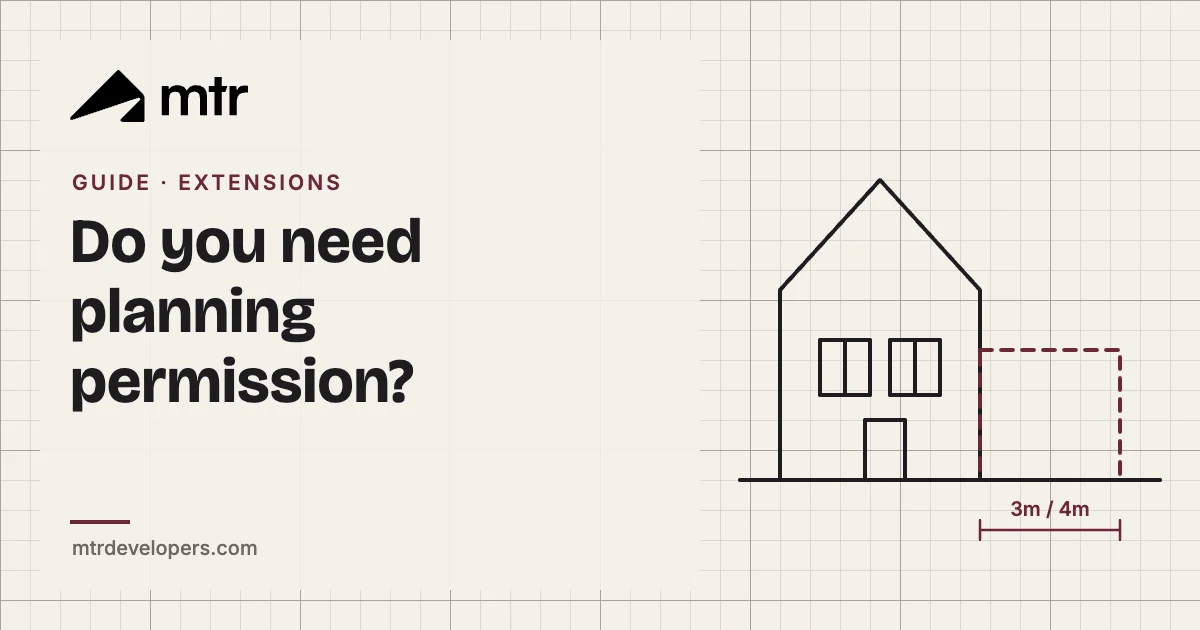
Do you need planning permission?: MTR Developments guide illustration

What is permitted development?

Permitted development rights let you extend your house without a planning application, as long as you stay inside national limits. The limits come from the General Permitted Development Order (legislation.gov.uk) and apply the same way in Birmingham and Bromsgrove. Flats and maisonettes don't have these rights.

How big can a single storey rear extension be without planning permission?

According to the Planning Portal:

  • Up to 3 metres beyond the original rear wall on a semi or terrace, or 4 metres on a detached house.
  • No more than 4 metres high.
  • No more than 3 metres high at the eaves if it sits within 2 metres of a boundary.
  • No higher than the existing roof, and no higher at the eaves than the existing eaves.
  • Extensions and outbuildings together can't cover more than half the land around the original house.
  • Materials must look similar to the existing house.

"Original house" means the house as first built, or as it stood on 1 July 1948. Any earlier extension counts against your allowance.

What about side extensions?

A single storey side extension can be up to 4 metres high and up to half the width of the original house (Planning Portal). In a conservation area, every side extension needs planning permission.

What is prior approval for a larger extension?

Prior approval lets you build a single storey rear extension up to 6 metres deep on a semi or terrace, or 8 metres on a detached house. You notify the council first, and the council writes to your neighbours. They get at least 21 days to comment. If the council hasn't given you a decision within 42 days, you can build what you submitted (GPDO Schedule 2, Part 1, Class A).

The fee is £240 (GOV.UK fees table). Birmingham City Council publishes a checklist for larger home extension applications.

When do you need full planning permission?

  • Your extension goes past the permitted development limits.
  • Your house sits in a conservation area or on other designated land.
  • The council has removed permitted development rights for your street or your house.
  • You want a rear extension of more than one storey on designated land.

A householder application in England costs £528 from 1 April 2025 (GOV.UK fees table). Most applications get a decision within 8 weeks (GOV.UK).

How do you prove an extension is permitted development?

Apply for a lawful development certificate. You don't have to, but it gives you written proof when you sell or remortgage. The fee is half the full application fee (GOV.UK fees table), so £264 for a householder extension.

Do you still need building regulations approval?

Yes. Planning decides whether you can build. Building regulations decide how. Most extensions need building regulations approval (Planning Portal). On a full plans application the council has five weeks to decide, or up to two months if you agree, and the approval lasts three years (Planning Portal).

How does the original house rule work in practice? (illustration)

Illustration only. This is not a past MTR job.

You own a semi in Bromsgrove. A previous owner added a 2 metre conservatory across the back in the 1990s. You want to replace it with a 4 metre kitchen diner. The 3 metre limit counts from the original rear wall, not from the conservatory, so 4 metres takes you past standard permitted development.

You have two routes. Apply for prior approval, which allows up to 6 metres on a semi, or make a householder planning application. Prior approval costs less and has a 42 day clock, so it usually wins when you sit outside a conservation area.

What is an Article 4 direction?

An Article 4 direction is a council order that removes some permitted development rights in a defined area. Where one covers your house, work that would normally count as permitted development needs a planning application instead. The Planning Portal tells you to check with your local planning authority for local rules before you start.

How do you check the rules for your own street?

Search your address on the Birmingham City Council or Bromsgrove District Council planning map. That shows whether you're in a conservation area or under an Article 4 direction. Still unsure? Apply for a lawful development certificate before you build.

Once planning is clear, read our extension cost guide for build prices. Lofts follow their own limits, covered in our loft conversion cost guide. Building on a shared wall? See party wall agreements: when you need one and what it costs.

Good to know

Questions people ask.

Not a standard permitted development extension. Under prior approval your neighbours can object, and the council weighs the impact on their homes before it decides.

Yes. Outbuildings and extensions together count towards the limit of half the land around the original house.

No. Flats and maisonettes have no householder permitted development rights for extensions, so you need planning permission.

The council can ask you to apply retrospectively, and can take enforcement action if it refuses. It also causes problems when you sell.

Keep reading

Related guides.

Next step

Get a price for your job.

Run your numbers through the cost calculator, or ask for a free quote. Quotes come back within 3 to 5 working days and stay valid for 30 days.