The price you sign is the price you pay. Every extra priced on day one. Nothing paid upfront. How it works
Services All services ExtensionsKitchensBathroomsLoft ConversionsRenovationsStructural Work
About Our Work Cost CalculatorLoft Conversion CostsExtension CostsGuides
Areas All areas BromsgroveAlvechurchBarnt GreenBlackwellRedditchBirminghamKings NortonNorthfieldSelly OakSolihullHalesowen
Contact Get a free quote
Home / Guides / Party wall agreements
Guide · Extensions

Party wall agreements: when you need one and what it costs

You need to serve party wall notice if you work on a shared wall, build a wall on the boundary, or dig foundations within 3 or 6 metres of a neighbour's building. If your neighbour agrees in writing, you avoid surveyor fees. If they don't, a surveyor writes an award, and you normally pay for it.

Last updated November 2026
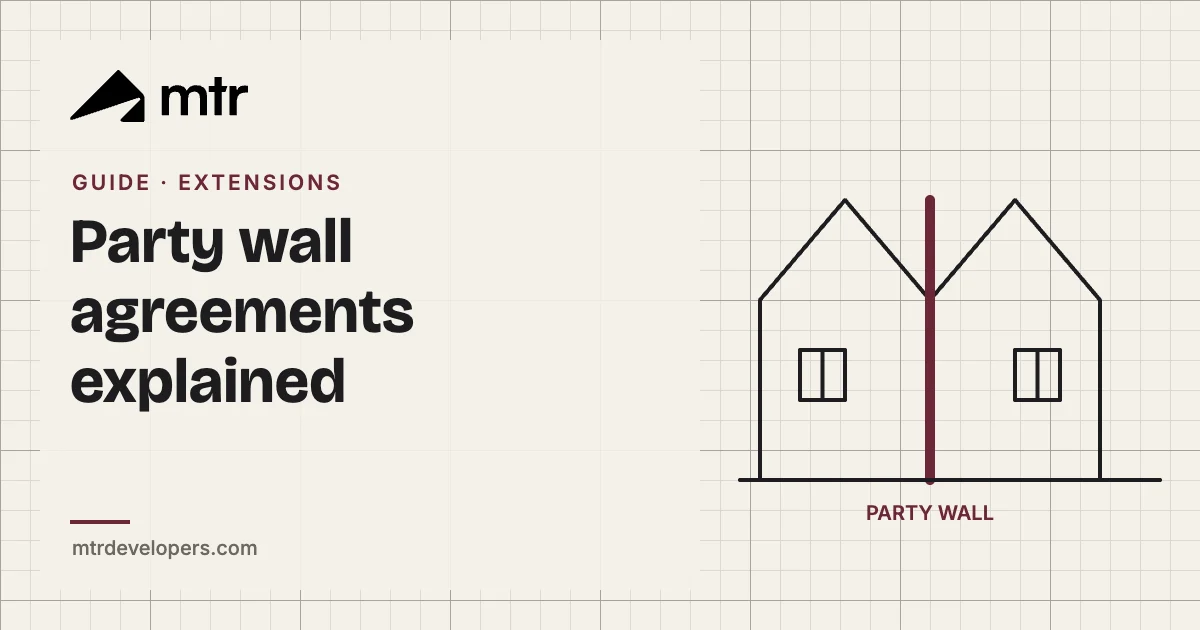
Party wall agreements explained: MTR Developments guide illustration

What is the Party Wall Act?

The Party Wall etc. Act 1996 sets out how you work on or near a wall you share with a neighbour in England and Wales (GOV.UK). It doesn't stop you building. It makes you tell your neighbour first, and gives them a way to protect their property.

When do you need a party wall agreement?

The government's explanatory booklet lists three kinds of work that need notice:

  • Work on an existing party wall. Cutting in a steel beam, raising or rebuilding the wall, underpinning it, or cutting in a flashing. Fixing shelves or replastering usually doesn't count.
  • A new wall on the boundary. Building up to the boundary line or astride it.
  • Digging near a neighbour. Excavating within 3 metres of their building and deeper than their foundations, or within 6 metres where you cut a 45 degree line down from their foundations.

Most rear extensions on terraces and semis trigger the digging rule. Most loft conversions trigger the party wall rule, because the steels sit in the shared wall.

How much notice do you have to give?

WorkNotice
Work on a party wallAt least two months
New wall on the boundaryAt least one month
Excavation within 3 or 6 metresAt least one month

Your neighbour can agree to an earlier start in writing. A notice lapses after a year, so don't serve it too early (explanatory booklet).

What goes in a party wall notice?

Your notice needs your name and address, the address of the building, a full description of the work and the date you plan to start. The explanatory booklet also says to date it and state clearly that it is a notice under the Act. Serve notice on every adjoining owner. That can mean both the freeholder and a leaseholder of the same property next door.

What happens if your neighbour doesn't reply?

Your neighbour has 14 days to respond. They can consent in writing, dissent, or say nothing. For party wall and excavation notices, silence after 14 days counts as a dispute (explanatory booklet).

A dispute means you each appoint a surveyor, or you agree one surveyor between you. The surveyor writes an award setting out how the work goes ahead. If your neighbour won't appoint anyone, you can appoint a second surveyor on their behalf so the job doesn't stall.

What does a party wall award cover?

The award sets out what work you can do, how and when you do it, and how the surveyors will check it. It usually includes a schedule of condition: photos and notes of your neighbour's side before work starts. If a crack appears later, both sides compare it against that record instead of arguing.

What does a party wall agreement cost?

If your neighbour consents in writing, you pay nothing beyond your own time serving the notice. If it goes to an award, you pay surveyor fees. Where the work only benefits you, you normally pay the costs of the award, including your neighbour's surveyor (explanatory booklet). The surveyors decide who pays.

Surveyors set their own fees. Ask each one for a fixed fee in writing before you appoint them. Party wall costs sit outside the build price, so add them to the figures in our extension cost guide or loft conversion cost guide.

Example: a terrace in Selly Oak (illustration)

Illustration only. This is not a past MTR job.

You own a mid terrace and plan a single storey rear extension plus a dormer loft. The extension foundations sit within 3 metres of both neighbours and go deeper than theirs, so you serve excavation notices on both sides. The loft steels bear on both party walls, so you serve party structure notices too. One neighbour signs consent. The other doesn't reply, so after 14 days you each appoint a surveyor, and the award comes back before work starts.

How do you keep party wall costs down?

Talk to your neighbour before the notice lands. Show them the drawings and explain the dates. A neighbour who hears about the job face to face is far more likely to consent in writing.

Serve notice as soon as your drawings are final, so the two months run alongside planning and building control. Our guide on how long an extension takes from quote to finished build shows how the timings stack up. For the planning side, read do you need planning permission for an extension.

Good to know

Questions people ask.

No. Planning permission and building regulations are separate approvals. You can hold both and still need to serve party wall notice.

No. The Act sets out how the work happens. It doesn't give your neighbour a veto.

The building owner serves it, or someone acting for them, such as a surveyor.

Surveyors usually photograph and record your neighbour's side before work starts. That record settles any later claim about damage.

Yes, if your neighbour agrees to receive notices that way. GOV.UK updated its guidance in 2016 to allow electronic notices.

Keep reading

Related guides.

Next step

Get a price for your job.

Run your numbers through the cost calculator, or ask for a free quote. Quotes come back within 3 to 5 working days and stay valid for 30 days.